


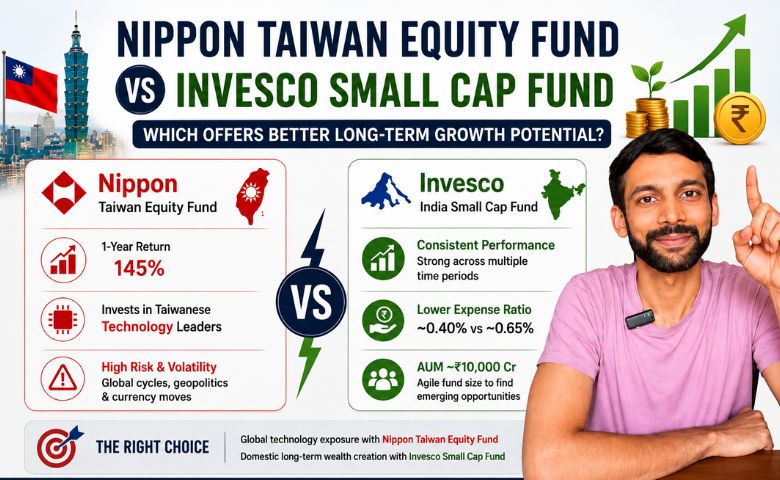
The Nippon India Taiwan Equity Fund has delivered exceptional performance over the past year, generating returns of more than 145%. It also recorded strong gains of nearly 20% in a single month, driven by renewed optimism in the technology sector.
The fund primarily invests in Taiwanese technology companies, giving investors exposure to one of the world's most important semiconductor manufacturing hubs. Taiwan is home to several global chip manufacturers that play a critical role in powering artificial intelligence, cloud computing, smartphones, electric vehicles, and advanced computing systems.
The rapid growth of AI has significantly increased demand for semiconductors, placing Taiwanese technology companies at the center of one of the biggest structural investment themes of the decade. As businesses continue adopting AI technologies, demand for high-performance chips may remain strong.
However, investors should remember that international thematic funds are inherently volatile. Their performance depends on global technology cycles, geopolitical developments, and currency movements. While recent returns have been impressive, these funds have also experienced periods of negative performance, making them more suitable as a satellite allocation rather than the core of an investment portfolio.
For investors seeking long-term wealth creation within India, small-cap mutual funds remain a compelling option. Among them, the Nippon India Small Cap Fund has historically been one of the strongest performers, delivering annualized returns of nearly 22% over the past ten years. Its long-term track record has made it an extremely widely held small-cap fund.
However, recent performance tells a different story. Over the past two years, the fund has lagged behind many of its peers, with more than half of the small-cap category outperforming it. This highlights an important reality of mutual fund investing—leadership changes over time, and no fund remains at the top forever.
One fund that has consistently attracted attention is the Invesco India Small Cap Fund. Instead of topping the charts in a single year, it has maintained a consistently strong position across multiple time periods, frequently ranking among the top-performing small-cap funds. Consistency is often a more valuable indicator than short-term outperformance.
The fund also has practical advantages. Its expense ratio of around 0.40% is lower than the approximately 0.65% charged by Nippon India Small Cap Fund, helping investors retain more of their long-term returns. Additionally, with assets under management of roughly ₹10,000 crore, the fund remains relatively agile, allowing the fund manager to identify and invest in emerging small-cap opportunities more efficiently.
Ultimately, choosing between these funds depends on your investment objective. Investors looking for global technology exposure may find the Nippon Taiwan Equity Fund attractive, while those focused on domestic long-term wealth creation may prefer diversified small-cap funds like Invesco India Small Cap Fund. Rather than chasing recent returns, investors should build a diversified portfolio aligned with their financial goals, risk tolerance, and investment horizon.
Note: This is not investment advice, all information shown is for educational purposes only. The schemes and performance data shown are for illustration only and are not to be construed as investment advice or recommendation to buy / sell any mutual fund or other instrument. Mutual fund investments are subject to market risks. Read all scheme related documents carefully before investing. Past performance is not indicative of future returns. Calculations shows are theoretical and not commitments or guarantees of returns. Consult your investment advisor before taking any decisions.